


One of the most common responses we hear after a website vulnerability scan is:
We don’t store any customer data on our website, so what’s the risk if it gets hacked?
It’s a fair question. Many businesses assume that if their website is simply a brochure site with a contact form, then a security vulnerability isn’t a significant concern.
Unfortunately, cybercriminals often have very little interest in your customer data. In many cases, they are interested in something far more valuable: your reputation, your search rankings, your domain authority, your customers’ trust, and your ability to do business.
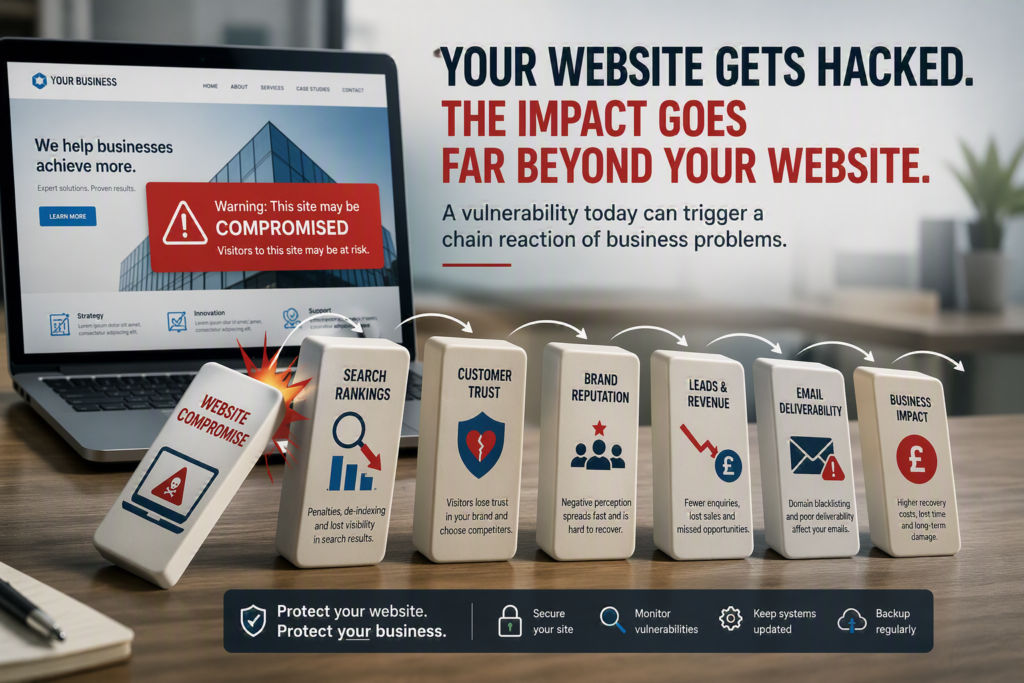
Your Website Is Part of Your Brand
Your website is often the first interaction a customer has with your business.
If a visitor arrives at your website and sees:
- A browser security warning
- A hacked homepage
- Malware alerts
- Spam content
- Redirects to malicious websites
they are unlikely to distinguish between “the website” and “the business”.
In their eyes, your company has been compromised.
The resulting loss of trust can be immediate and difficult to recover from. Customers may question not only your website security but also your professionalism, reliability, and overall ability to protect their interests.
Search Engine Rankings Can Collapse Overnight
Many businesses invest heavily in SEO, content creation, and digital marketing.
A successful website compromise can undo years of work.
Hackers commonly:
- Inject spam pages
- Add hidden links
- Insert malicious code
- Create phishing content
- Redirect visitors elsewhere
When search engines detect these activities, they may:
- Flag the website as dangerous
- Display security warnings in search results
- Remove pages from their index
- Significantly reduce rankings
The result can be a dramatic drop in organic traffic and lead generation. Recovering rankings can take months, even after the website has been cleaned and secured.
Your Website Can Be Used to Attack Others
A compromised website often becomes a launch platform for further attacks.
Cybercriminals frequently use hacked websites to:
- Host malware
- Run phishing campaigns
- Distribute malicious downloads
- Send spam emails
- Redirect visitors to scam websites
Your website effectively becomes a tool used for criminal purposes.
Customers, suppliers, and partners who encounter these attacks may associate the activity with your business regardless of who carried it out.
Business Operations Can Be Disrupted
Many organisations underestimate how dependent they are on their website.
A website outage can impact:
- Lead generation
- Online enquiries
- Recruitment
- Customer support
- Marketing campaigns
- Partner referrals
Even businesses that do not sell online often rely heavily on their website to generate business opportunities.
A compromise can result in lost enquiries, missed opportunities, and frustrated customers.
Email Reputation Can Be Damaged
Many website vulnerabilities provide attackers with a route into your hosting environment.
Once inside, they may use your domain to send spam or phishing emails.
Consequences can include:
- Domain blacklisting
- Reduced email deliverability
- Legitimate messages landing in junk folders
- Damage to supplier and customer trust
Businesses often discover this problem only after customers start reporting that emails are not arriving. This can affect sales, support, invoicing, and day-to-day communication.
Recovery Is Often More Expensive Than Prevention
The cost of a security incident is rarely limited to fixing the website.
Businesses frequently incur costs associated with:
- Emergency remediation work
- Forensic investigations
- Website rebuilds
- Lost marketing spend
- Lost sales opportunities
- SEO recovery
- Reputation management
A vulnerability that could have been resolved in minutes can ultimately result in weeks or months of disruption.
Compliance and Insurance Implications
Even if no customer data is stored on the website, vulnerabilities can raise questions around:
- Cyber Essentials requirements
- Cyber insurance obligations
- Supplier security assessments
- Contractual security commitments
Many organisations are now expected to demonstrate that internet-facing systems are maintained and protected against known vulnerabilities.
Ignoring known weaknesses can be difficult to justify following a security incident.
Criminals Don’t Choose Targets Based on Data Alone
A common misconception is:
Nobody would bother attacking our small business.
In reality, most website attacks are automated.
Attackers continuously scan the internet looking for:
- Outdated software
- Unpatched plugins
- Weak passwords
- Misconfigurations
- Known vulnerabilities
The attack usually isn’t personal. Your website is simply one of thousands being automatically tested for weaknesses.
What would it cost your business if customers could no longer trust your website?
A website compromise can impact:
- Brand reputation
- Customer confidence
- Search rankings
- Lead generation
- Email delivery
- Operational continuity
- Regulatory compliance
Even organisations with no customer data stored on their website still have significant exposure.
Cybersecurity isn’t just about protecting information. It’s about protecting the ability of your business to operate, attract customers, and maintain trust.
If your website is part of your brand, then your website security is part of your business security.
Reduce the Risk with Managed WordPress Hosting
Keeping a website secure requires more than installing an occasional update. WordPress itself, its plugins, themes, hosting environment and security controls all need to be monitored and maintained.
Globe2’s managed WordPress hosting service helps protect business websites through proactive updates, security monitoring, malware scanning, managed backups and ongoing technical support. We take responsibility for the hosting and maintenance of your website, helping to identify and resolve issues before they become costly security incidents.
Even when your website does not store customer data, it still protects something valuable: your reputation, your visibility and your ability to generate business.